What is Activated Carbon in Water Treatment?
High purity activated carbon is a highly effective adsorber of organic compounds and is used to remove residual organic compounds in purified water. These may come from the feed-water or leached from the system or the ion exchange resins. It is a valuable aid in maintaining low TOC values, complementing UV oxidation.
Why Choose Us
High quality
Our products are manufactured or executed to very high standards, using the finest materials and manufacturing processes.
Competitive Price
We offering a higher-quality product or service at an equivalent price. As a result we have a growing and loyal customer base.
Rich experience
Our company has many years of production work experience. The concept of customer-oriented and win-win cooperation makes the company more mature and stronger.
Global shipping
Our products support global shipping and the logistics system is complete, so our customers are all over the world.
After-sale service
Professional and thoughtful after -sales team, let you worry about us after -sales Intimate service, strong after -sales team support.
Advanced equipment
A machine, tool or instrument designed with advanced technology and functionality to perform highly specific tasks with greater precision, efficiency and reliability.
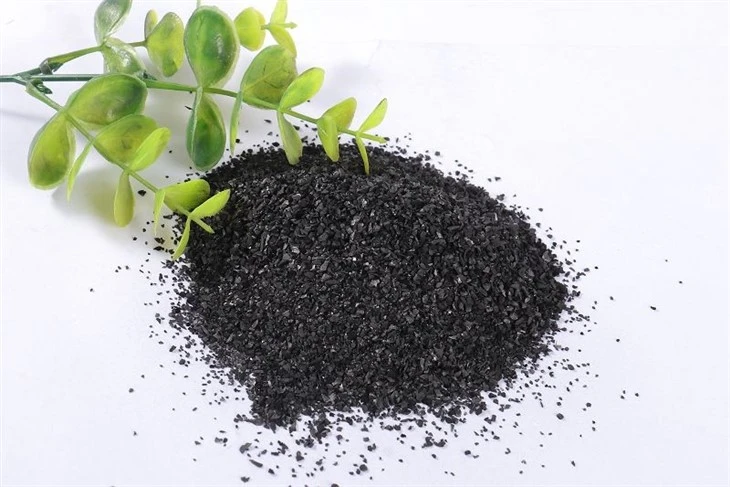
Nut shell activated carbon is a new type of activated carbon made from peach shell, apricot shell and other nutshell, activated by high temperature, carbonization, and loaded with photocatalyst and carbon fiber. It is widely used in gas treatment, sewage treatment, desulfurization and denitration, solvent recovery, nitrogen generation, air separation equipment, paint workshop and other fields.
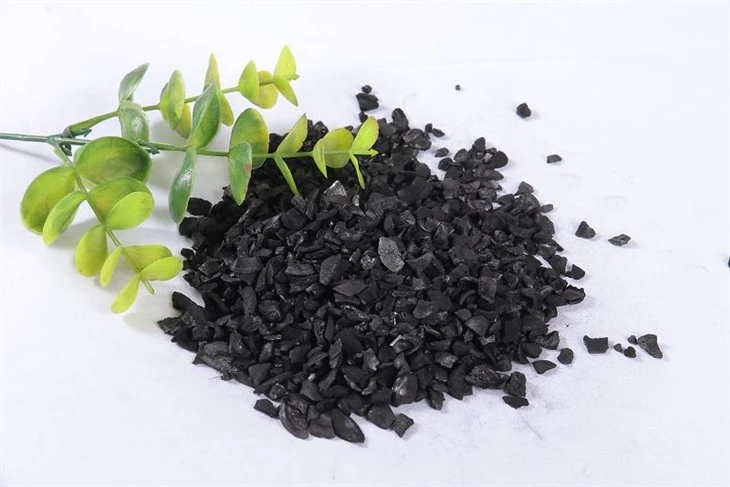
Nut shell activated carbon is a new type of activated carbon made from peach shell, apricot shell and other nutshell, activated by high temperature, carbonization, and loaded with photocatalyst and carbon fiber.

Activated carbon (also called activated charcoal, activated coal or active carbon) is a very useful adsorbent. Due to their high surface area, pore structure (micro, meso and macro), and high degree of surface reactivity, activated carbon can be used to purify, dechlorinate, deodorize and decolorize both liquid and vapor applications.

Activated Carbon in Water Treatment
Remove sediment from alcohol.
Absorb odors and pigments in the wine.
Filter medium in wine.
Benefits of Activated Carbon for Water Treatment Systems
The United States EPA recognizes a number of benefits to utilizing granular activated carbon in wastewater treatment, all of which can also be applied to drinking and process water treatment facilities.
Accepts a Wide Range of Materials
The EPA lists a variety of both organic and inorganic components that can be adsorbed from water by granular activated carbon:

Easy Integration
A GAC system is easily incorporated into existing facility infrastructure.
Small Footprint
GAC systems require only a small footprint, making them a particularly attractive option for facilities with limited space.
Proven in Large-Scale Settings
The EPA recognizes granular activated carbon systems as a proven and reliable approach for removing dissolved organics in high-volume settings.
Cost Savings When Reactivated
Activated carbon can be regenerated, meaning that the "spent" carbon can be processed (typically in a rotary kiln) to be reused; the adsorbed components can be desorbed, and the spent carbon reactivated, allowing it to be reused repeatedly.
Not all activated carbons are reactivated (powdered activated carbon is typically disposed of). However, reactivation is an attractive feature because it costs significantly less than purchasing virgin activated carbon, and also results in a lower carbon footprint; it takes much less energy to reactivate carbon than it does to produce virgin carbon.
Depending on the location and capacity requirements of a treatment facility, on-site reactivation may offer economic benefits. Remote or isolated operations may find that the shipping costs required to transport spent carbon to a commercial reactivation facility will outweigh the cost of an on-site reactivation operation.
Water treatment with activated carbon is an adsorption process, in which impurities are trapped, by adsorption, on the surface of the carbon particles.
The activated carbon particles have a porous micro-structure with a very large surface area.
The adsorption efficiency depends on: the size of the molecules, the size of the pores, the surface area, the concentration of particles, the temperature, the contact time and other parameters.
The adsorption process
Adsorption is a phenomenon of concentration of molecules, or particles, on the surface of a solid. The "adsorbent" can be any solid material that has bonding sites, to which the adsorbate can bind.
The most common commercial adsorbent used in water treatment is activated carbon.
Applications of Activated Carbon In Water Treatment
Filtration with activated carbon is used to:
Eliminate taste and odor from water.
Reduce health risks.
Prevent damage to the reverse osmosis membranes and to ion exchange resins.
Tertiary treatment of wastewater.
Pretreatment of industrial water and more.
What is So Special About Activated Carbon?
Activated carbon is a carbon that has been processed to increase its surface area to a magnitude of around 1000 m2/g.
Its structure results in a very high amount of small pores between carbon atoms, and very high surface area.
A few grams (≈ 5 grams) of activated carbon have a surface area equal to that of a football field!
Activated carbon is hydrophobic and has a strong affinity for organic compounds and non-polar contaminants. Van der Waals forces are responsible for the adsorption process.
Raw Materials Of Activated Carbon
There are different types of activated carbons, each with its specific properties. It is made of many different raw materials that have a high carbon content, for example:
Mineral carbon
Wood
Coconut shells
Bamboo etc.
Activated carbon must have a large volume of micropores, in an adequate distribution, allowing adsorption of molecules of different sizes.
In addition, it must contain larger pores, to facilitate the access of molecules to the smallest pores.
Therefore, to meet the specific pore size distribution requirements, the production process must be controlled.
Precautions for Using Activated Carbon for Water Treatment


When using activated carbon in water treatment, the following matters need to be noted to ensure its maximum efficiency and safety:
Pretreatment: Before using activated carbon, water is usually pretreated, such as sedimentation, filtration, etc., to remove large suspended solids and silt, which can prevent the activated carbon pores from clogging and extend its service life.
Water temperature control: The adsorption performance of activated carbon is related to water temperature. Generally speaking, higher water temperature can enhance the adsorption effect of activated carbon, but it should not be too high to avoid affecting other aspects of the water treatment process.
Contact time: In order to achieve the best adsorption effect, the contact time between water and activated carbon should be long enough. Usually when designing a system, it is necessary to determine the appropriate contact time based on the water quality and the properties of activated carbon.
Activated carbon replacement: After adsorbing a certain amount of pollutants, activated carbon will gradually become saturated and its adsorption capacity will decrease. Therefore, it is necessary to regularly monitor the adsorption effect of activated carbon and replace or regenerate it in time as needed.
Avoid secondary pollution: After using activated carbon, waste activated carbon containing pollutants needs to be properly disposed of to avoid secondary pollution. The regeneration of waste carbon also needs to comply with relevant environmental protection regulations.
Use in moderation: According to the specific water quality and treatment requirements, the amount of activated carbon should be reasonably added to avoid excessive use and waste of resources.
Avoid cross-contamination: Different types of pollutants will affect each other's adsorption. When using, pollutants of similar properties should be treated together as much as possible to improve the adsorption efficiency. If necessary, different types of activated carbon may need to be used in stages or steps.
System maintenance: Regularly test and maintain each link of the water treatment system to ensure that the activated carbon can work in the best condition.
Safety precautions: Pay attention to personal protection when handling and replacing activated carbon, avoid inhaling dust or direct contact with the skin, and ensure that the workplace is well ventilated.
By paying attention to the above matters, activated carbon can be used more effectively for water treatment, ensuring the effect of water quality improvement, while ensuring economy and environmental protection.
How To Determine Whether the Shell Activated Carbon is Invalid?
Take an appropriate amount of new activated carbon, use colored water as a gas adsorption experiment, such as using a beverage bottle, add an appropriate amount of activated carbon (the amount of activated carbon can be determined by yourself), and add tap water to the bottle (the amount can be determined by yourself, but not too much ), then put the activated carbon into the bottle, drop a small amount of xanthate or methyl blue, etc. (the amount can be set by yourself, but not too much), shake or stand for a certain period of time, and then take out the solution in the bottle (without activated carbon ), this is solution Otherwise repeat the above process, only adding no activated carbon and only adding drugs, as the solution B without activated carbon treatment.
Finally, you can compare the used activated carbon as an experiment, and see where the water color in the bottle is between Solution A or B, and then you can judge whether the activated carbon still has the effect of using it. It should be noted that the amount of activated carbon added, the amount of clean water, the amount of medicine, and the shaking time must be fixed.
The pores of activated carbon are roughly divided into large, medium and micro pores. These three types of pores exist in each activated carbon. As for which one accounts for more components, it depends on the raw materials and manufacturing conditions.
It is advisable to use nutshell activated carbon because the gas adsorption capacity of nutshell activated carbon is higher. The apparent density is mostly lower than 0.45 g/ml, and the ash content is mostly lower than 5%. When the specific gravity and ash content of the activated carbon are lower, it means that there is no too much With more inorganic salts and impurities, the ratio of pores is higher, so the gas adsorption ability is relatively improved.
Nutshell activated carbon is used for solar street lights and wastewater treatment. Microfiltration is this kind of precision filtration technology. The diameter range is usually 0.05/10/m, which is close to the middle of the basic filter and ultrafiltration membrane. Unlike the basic filter, it belongs to the separation and extraction purpose under the working pressure drive, without changing the phase state, and does not produce the migration of page quality. Basic filtering is usually divided into deep filtering and residual filtering.
The materials it uses, such as paper, asbestos, glass fiber, porcelain, cloth, felt, etc., are all porous structures, with an extremely porous structure, and their diameters are so wide that they cannot be marked. size. When it is over-filtered, the object is blocked due to the rough fluidity of falling into the substance. The interception rate is B6, the working pressure is adjusted, the material is thin and thick, and the particle size is large, which is suitable for normal filtering.
The replacement circulation system of the nut shell activated carbon is related to the leaking water body. Whether the shell activated carbon is completely ineffective should be determined based on the water content of organic compounds in the import and export trade of activated carbon. After all normal backwashing, it is determined that the water content of the soil organic matter at the inlet and outlet is higher than that of the imported organic compounds.
This means that the activated carbon of the shell has expired and needs to be regenerated or replaced. The replacement cycle time of shell activated carbon is usually 1 to 2 years (the actual time should be determined based on the leaking water body, the amount of activated carbon in the shell, and the accumulated operation time). Therefore, while understanding the price of activated carbon, people should also pay attention to how to use activated carbon in daily life, otherwise I don't know how to use it is not such a luxury and waste.
Our Factory
Hongsen company, founded in 2000, is a professional manufacturer of activated carbon in Shijiazhuang City, Hebei Province, and currently produces various multi-purpose series of activated carbon. The company has passed ISO9001:2008 quality management system. The company researches and develops various series of activated carbon, forming a vertically integrated business structure from raw material collection and processing to product terminal sales.

FAQ
Hot Tags: activated carbon in water treatment, China activated carbon in water treatment manufacturers, suppliers, Granular Activated Carbon Coconut Shell, Coal Based Granular Activated Carbon, Carbon Active Coal, Active Carbon Production From Coal, activated carbon for purification, activated carbon adsorbent